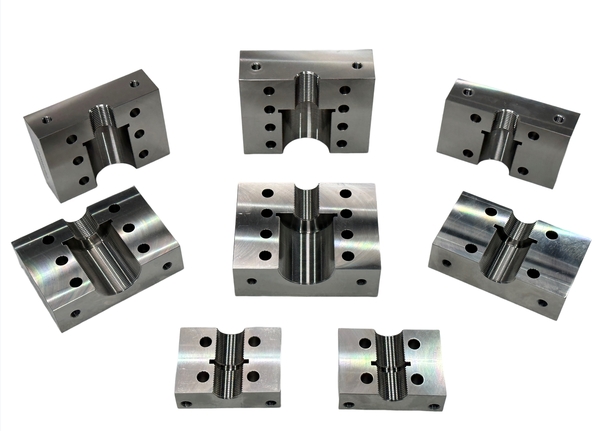
Mechanical processing refers to the process of changing the overall size or performance of a workpiece through a mechanical device. In the production process, the process of changing the shape, size, position, and nature of the production object to become a finished or semi-finished product is called a process. It is the main part of the production process. The process can also be divided into casting, forging, stamping, welding, mechanical processing, assembly and other processes. The mechanical manufacturing process generally refers to the sum of the mechanical processing process of the parts and the assembly process of the machine. Other processes are called auxiliary processes, such as transportation, storage, power supply, equipment maintenance, etc. A process is composed of one or several sequentially arranged processes, with a process consisting of several steps.
1: Turning
During turning, the workpiece rotates to form the main cutting motion. When the tool moves along the parallel axis of rotation, it forms an inner and outer cylindrical surface. The tool moves along a diagonal line that intersects with the axis, forming a conical surface. On a copying lathe or CNC lathe, the tool can be controlled to feed along a curve, forming a specific rotating surface. By using formed turning tools, rotating surfaces can also be machined during cross feed. Turning can also process threaded surfaces, end planes, and eccentric shafts. The machining accuracy of turning is generally IT8-IT7, and the surface roughness is 6.3-1.6 μ M. When precision turning, it can reach IT6-IT5, and the roughness can reach 0.4-0.1 μ M. The productivity of turning is relatively high, the cutting process is relatively smooth, and the tool is relatively simple.
2: Milling
The main cutting motion is the rotation of the tool. During horizontal milling, the formation of a flat surface is formed by the blades on the outer cylindrical surface of the milling cutter. During end milling, the flat surface is formed by the end face edge of the milling cutter. Increasing the speed of the milling cutter can achieve higher cutting speed, resulting in higher productivity. However, due to the impact caused by the cutting in and out of the milling cutter teeth, the cutting process is prone to vibration, which limits the improvement of surface quality. This impact also exacerbates the wear and damage of the cutting tool, often leading to the fragmentation of the hard alloy blade. During the general time of cutting off the workpiece, a certain amount of cooling can be obtained, so the heat dissipation conditions are good. According to the same or opposite direction of the main motion speed and the workpiece feed direction during milling, it is further divided into forward milling and reverse milling. Forward milling
The horizontal component of milling force is the same as the feed direction of the workpiece, and there is generally a gap between the feed screw of the workpiece table and the fixed nut. Therefore, cutting force is prone to causing the workpiece and workbench to move forward together, causing a sudden increase in feed rate and causing cutting. When milling workpieces with surface hardness such as castings or forgings, the teeth of the milling cutter first come into contact with the hard skin of the workpiece, exacerbating the wear of the milling cutter. Reverse milling can avoid the movement phenomenon that occurs during forward milling. During reverse milling, the cutting thickness gradually increases from zero, thus the blade undergoes a stage of squeezing and sliding on the hardened machined surface, accelerating tool wear. Meanwhile, during reverse milling, the milling force lifts the workpiece up, which can easily cause vibration, which is a disadvantage of reverse milling.
The machining accuracy of milling can generally reach IT8-IT7, and the surface roughness is 6.3-1.6 μ M.
Ordinary milling can generally only process flat surfaces, and fixed curved surfaces can also be machined using forming milling cutters. CNC milling machines can use software to control several axes in a certain relationship through the CNC system, milling complex surfaces. In this case, ball end milling cutters are generally used. CNC milling machines are of great significance for processing complex shaped workpieces such as blades, mold cores, and cavities in turbomachinery.
3: Planing
During planing, the reciprocating linear motion of the tool is the main cutting motion. Therefore, the cutting speed cannot be too high and the productivity is low. Planing is smoother than milling, and its processing accuracy can generally reach IT8-IT7, with a surface roughness of Ra6.3-1.6 μ m. The flatness of precision planing can reach 0.02/1000, and the surface roughness is 0.8-0.4 μ M.
4: Grinding
Grinding uses grinding wheels or other grinding tools to process workpieces, with the main motion being the rotation of the grinding wheel. The grinding process of a grinding wheel is actually a comprehensive effect of the cutting, engraving, and sliding effects of abrasive particles on the surface of the workpiece. In grinding, the abrasive particles themselves gradually become blunt from sharpness, resulting in reduced cutting effect and increased cutting force. When the cutting force exceeds the strength of the adhesive, the blunt abrasive particles fall off, revealing a new layer of abrasive particles, forming the "self sharpening" of the grinding wheel. But chips and abrasive particles will still block the grinding wheel. Therefore, after grinding for a certain period of time, it is necessary to use diamond turning tools to trim the grinding wheel.
During grinding, due to the many cutting edges, the machining process is smooth and accurate. Grinding machine is a precision machining machine tool, with grinding accuracy up to IT6-IT4 and surface roughness Ra up to 1.25-0.01 μ m. Even up to 0.1-0.008 μ M. Another characteristic of grinding is the ability to process hardened metal materials. Therefore, it is often used as the final processing step. During grinding, a large amount of heat is generated and sufficient cutting fluid is required for cooling. According to different functions, grinding can also be divided into outer circle grinding, inner hole grinding, flat grinding, etc.
5: Drilling and Boring
On a drilling machine, rotating the drill bit to drill holes is the most commonly used method for hole processing. The machining accuracy of drilling is relatively low, usually only reaching IT10, and the surface roughness is generally 12.5-6.3 μ After drilling, m often uses reaming and reaming for semi precision machining and precision machining. The reaming is carried out using a reaming drill, and the reaming is processed using a reamer. The precision of hinge machining is generally IT9-IT6, and the surface roughness is Ra1.6-0.4 μ M. When expanding or reaming, the drill bit and reamer generally follow the axis of the original bottom hole, which cannot improve the accuracy of the hole position. Boring can be aligned with the position of the hole. Boring can be carried out on a boring machine or lathe. When boring holes on a boring machine, the boring tool is basically the same as the turning tool, except that the workpiece does not move and the boring tool rotates. The machining accuracy of boring holes is generally IT9-IT7, and the surface roughness is Ra6.3-0.8mm.. Drilling processing, boring machine processing, lathe processing
6: Tooth surface processing
The machining methods for gear tooth surfaces can be divided into two categories: forming method and generating method. The machine tool used for machining tooth surfaces using the forming method is generally a regular milling machine, and the cutting tool is a forming milling cutter, which requires two simple forming movements: the rotating motion of the cutting tool and the linear movement. The commonly used machine tools for generating tooth surfaces include gear hobbing machines, gear shaping machines, etc.
7: Complex surface machining
The cutting process of three-dimensional surfaces mainly adopts the methods of profile milling and CNC milling, or special machining methods (see Section 8 of this section). Copying milling must have a prototype as a model. During processing, the ball head profiling head continuously contacts the prototype surface under a certain pressure. The motion of the profiling head is transformed into inductance, and the machining amplification controls the motion of the three axes of the milling machine, forming the trajectory of the tool head moving along the curved surface. Milling cutters often use ball end milling cutters with the same radius as the profiling head. The emergence of CNC technology provides more effective methods for surface machining. When machining on a CNC milling machine or machining center, it is achieved by machining point by point with a ball end milling cutter according to coordinate values. The advantage of using a machining center to process complex surfaces is that there is a tool library on the machining center, equipped with dozens of tools. For rough and fine machining of curved surfaces, different cutting tools can be used for different curvature radii of concave surfaces, and appropriate cutting tools can also be selected. At the same time, various auxiliary surfaces such as holes, threads, grooves, etc. can be machined in one installation. This fully ensures the relative position accuracy of each surface.
8: Special processing
Special machining methods refer to a series of machining methods that use chemical, physical (electrical, acoustic, optical, thermal, magnetic) or electrochemical methods to process workpiece materials, which are different from traditional cutting methods. These machining methods include chemical machining (CHM), electrochemical machining (ECM), electrochemical mechanical machining (ECMM), electric discharge machining (EDM), electrical contact machining (RHM), ultrasonic machining (USM), laser beam machining (LBM), ion beam machining (IBM), electron beam machining (EBM), plasma machining (PAM), electrohydraulic machining (EHM), abrasive flow machining (AFM), abrasive jet machining (AJM), liquid jet machining (HDM), and various composite machining.
Electric discharge machining
Electrical discharge machining (EDM) is achieved by utilizing the high-temperature erosion of the workpiece surface material generated by the instantaneous spark discharge between the tool electrode and the workpiece electrode. Electric discharge machining machine tools are generally composed of pulse power supply, automatic feed mechanism, machine body, and working fluid circulation and filtration system. The workpiece is fixed on the machine tool workbench. The pulse power supply provides the energy required for processing, with its two poles connected to the tool electrode and the workpiece respectively. When the tool electrode and workpiece approach each other in the working fluid driven by the feed mechanism, the voltage between the electrodes breaks through the gap and generates spark discharge, releasing a large amount of heat. After absorbing heat on the surface of the workpiece, it reaches a very high temperature (above 10000 ℃), and local materials are corroded off due to melting or even gasification, forming a small pit. The working fluid circulation filtration system forces the cleaned working fluid to pass through the gap between the tool electrode and the workpiece at a certain pressure, timely eliminating the corrosion products, and filtering them out of the working fluid. As a result of multiple discharges, a large number of pits are generated on the surface of the workpiece. The tool electrode is continuously lowered under the drive of the feed mechanism, and its contour shape is "copied" onto the workpiece (although the tool electrode material may also be eroded, its speed is much lower than the workpiece material). Electrical discharge forming machine tool for machining corresponding workpieces with special shaped electrode tools————
① Processing hard, brittle, tough, soft, and high melting point conductive materials; ② Processing semiconductor materials and non-conductive materials; ③ Processing various types of holes, curved holes, and micro holes;
④ Processing various three-dimensional curved surface cavities, such as forging molds, die-casting molds, and plastic mold cavities;
⑤ Used for cutting, cutting, surface strengthening, engraving, printing nameplates and markings, etc. Electric discharge wire cutting machine tool for machining two-dimensional contour shaped workpieces with wire electrodes
Electrolytic machining
Electrochemical machining is a method of forming workpieces using the electrochemical principle of anodic dissolution of metals in electrolyte. The workpiece is connected to the positive pole of the DC power supply, the tool is connected to the negative pole, and a narrow gap (0.1mm~0.8mm) is maintained between the two poles. An electrolyte with a certain pressure (0.5MPa~2.5MPa) flows through the gap between the two electrodes at a high speed of 15m/s~60m/s. When the cathode of the tool continuously feeds into the workpiece, the metal material continuously dissolves on the surface of the workpiece facing the cathode according to the shape of the cathode surface, and the electrolytic products are taken away by the high-speed electrolyte. Therefore, the shape of the tool surface is correspondingly "copied" on the workpiece————
① Low working voltage and high working current;
② Process complex shaped surfaces or cavities in one go with simple feed motion; ③ Machinable and difficult to process materials;
④ The productivity is relatively high, about 5-10 times that of electric discharge machining;
⑤ No mechanical cutting force or cutting heat during processing, suitable for processing easily deformed or thin-walled parts; ⑥ The average machining tolerance can reach around ± 0.1mm; ⑦ Multiple auxiliary equipment, large footprint, and high cost;
⑧ Electrolyte not only corrodes machine tools but also easily pollutes the environment. Electrochemical machining is mainly used for machining holes, cavities, complex surfaces, small diameter deep holes, rifling, as well as for deburring and engraving.
Laser processing
The laser processing of the workpiece is completed by a laser processing machine. Laser processing machines are usually composed of lasers, power supplies, optical systems, and mechanical systems. Lasers (commonly used include solid-state lasers and gas lasers) convert electrical energy into light energy, generating the required laser beam, which is focused by an optical system and then irradiated on the workpiece for processing. The workpiece is fixed on a three-dimensional precision workbench and controlled and driven by a CNC system to complete the required feed motion for machining No machining tools required;
② The power density of the laser beam is very high, and it can process almost any difficult to machine metal and non-metallic material; ③ Laser processing is non-contact processing, with no deformation of the workpiece under force;
④ The speed of laser drilling and cutting is very high, and the materials around the processing area are almost unaffected by cutting heat, resulting in minimal thermal deformation of the workpiece Laser cutting has narrow slits and good cutting edge quality. Laser processing has been widely used for small hole machining of diamond wire drawing dies, watch gemstone bearings, porous skin of divergent air-cooled punching sheets, engine fuel nozzles, aviation engine blades, and cutting of various metal and non-metallic materials.
Ultrasonic machining
Ultrasonic machining is a method of using ultrasonic frequency (16KHz~25KHz) to vibrate the tool end face and impact the suspended abrasive in the working fluid. The abrasive particles impact and polish the surface of the workpiece to achieve workpiece machining. The ultrasonic generator converts power frequency AC electrical energy into ultrasonic frequency electrical oscillation with a certain power output, and converts this ultrasonic frequency electrical oscillation into ultrasonic mechanical vibration through a transducer. With the help of an amplitude amplification rod, the displacement amplitude of the vibration is amplified from 0.005mm to 0.01mm to 0.01-0.15mm, driving the tool to vibrate. The tool end face impacts the suspended abrasive particles in the working fluid during vibration, causing them to continuously impact and polish the processed surface at a high speed, crushing the material in the processing area into very fine particles and striking them down. Although there is very little material produced during each blow, there is still a certain processing speed due to the high frequency of blows. Due to the circulating flow of the working fluid, the material particles that have been knocked down are promptly taken away. As the tool gradually extends in, its shape is "copied" onto the workpiece——————————————
When machining difficult to cut materials, ultrasonic vibration is often combined with other machining methods for composite machining, such as ultrasonic turning, ultrasonic grinding, ultrasonic electrochemical machining, ultrasonic wire cutting, etc. These composite processing methods combine two or even multiple processing methods, which can play a role in complementing each other's strengths and weaknesses, significantly improving processing efficiency, accuracy, and surface quality of the workpiece.
 Email : changjin@xinchangjin.net
 Home
Home Category
 Telephone
 Contact