Comparison and Performance Analysis of Wire Rope Electric Hoists (Type N) in China, Japan, and South Korea
Release time : 2025-03-29Author : XINCHANGJIN MACHINERYRead : 1898times
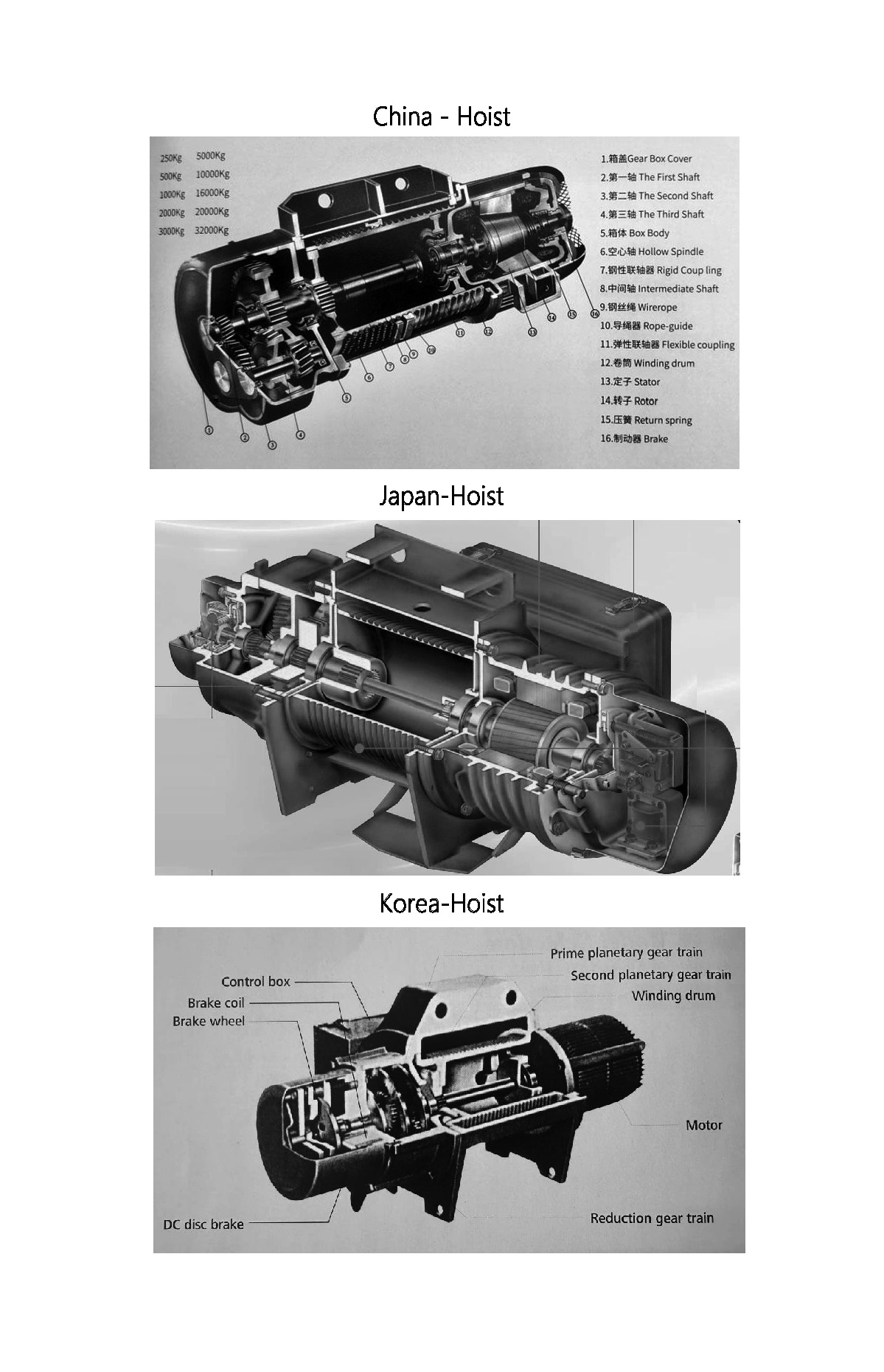
Comparison and Performance Analysis of
Wire Rope Electric Hoists (Type N) in China, Japan, and South Korea
Electric hoists, as core components of
lifting equipment, rely heavily on mechanical design to determine performance,
safety, and maintenance efficiency. This article compares the structural and
technical specifications of N-type wire rope electric hoists from China, Japan,
and South Korea, focusing on core components, braking systems, reduction
mechanisms, and innovative designs.
I. Comparison of Main Frame and Core
Components
-
South Korean Electric Hoist
-
Structural Features:
-
The
main frame assembly (MAIN BODY Assembly) integrates a planetary gear
reducer, multi-stage DC electromagnetic brake, and a three-phase
asynchronous motor, with independent installation of components.
-
Planetary Gear Reducer: Utilizes a two-stage planetary gear
transmission (including 1st/2nd internal gears and planet gear cages)
for high transmission efficiency and load distribution.
-
Motor Gear Shaft: Directly connected to the brake, shortening
the power transfer path.
-
Advantages: Modular design simplifies repairs; planetary gears
offer strong impact resistance and stable torque output.
-
Chinese Electric Hoist
-
Structural Features:
-
The main structure includes a conical rotor motor,
three-stage helical gear reducer, flexible coupling, and cast iron/steel
tube winding drum.
-
Reducer: Employs three-stage helical gears, with the input
shaft connected to the motor via a flexible coupling and the output
shaft (hollow shaft) driving the drum.
-
Braking System: Relies on the axial magnetic pull of the
conical rotor and spring linkage, with the brake wheel coaxial to the
motor.
-
Advantages: Clear power transmission path and low
manufacturing cost; conical rotor ensures rapid braking response and high
safety.
-
Japanese Electric Hoist
-
Structural Features:
-
Integrates an electromagnetic brake lifting motor with a
multi-stage gearbox, featuring an independent brake unit.
-
Innovations: Auxiliary brake unit (redundant braking), new
steel drum and sheave mechanisms, user-friendly pushbuttons, and
integrated cables.
-
Advantages: Rapid technological iteration with human-machine
interaction focus; auxiliary braking enhances safety, and modularity
simplifies inspection.
II. Key Performance Comparisons
-
Braking System
-
South Korea: Multi-stage DC electromagnetic brake (4 friction
plates), independent of the motor and gearbox, ensures direct braking
response and superior heat dissipation.
-
China: Conical rotor magnetic pull braking with spring reset
requires periodic adjustment for wear (axial displacement up to 3–5 mm).
-
Japan: Dual protection via primary electromagnetic brake +
auxiliary braking unit; automatic wear compensation reduces maintenance
frequency.
-
Reduction Mechanism
-
South Korea: Two-stage planetary gears offer compact size,
over 95% transmission efficiency, and outstanding impact resistance.
-
China: Traditional three-stage helical gears ensure mature
technology and low maintenance costs; rolling bearings minimize friction
losses.
-
Japan: Multi-stage gearbox (possibly combining planetary and
parallel shafts) balances efficiency and load adaptability with optimized
noise control.
-
Motor and Power Transmission
-
South Korea: Three-phase asynchronous motor transfers power
via a middle shaft to the planetary gearbox, ensuring smooth torque
output.
-
China: Conical rotor motor enables direct braking via axial
magnetic pull, offering quick start-stop but higher energy consumption.
-
Japan: Integrated electromagnetic brake lifting motor reduces
power loss and improves control precision.
III. Innovative Designs and Application
Scenarios
-
South Korea:
-
Highlights: Modular design, multi-stage brake heat
dissipation.
-
Applications: High-frequency lifting operations, heavy
industries (e.g., ports, steel plants).
-
China:
-
Highlights: Cost-effective conical rotor braking, robust
three-stage gears.
-
Applications: Small-to-medium workshops, construction sites
(cost-sensitive environments).
-
Japan:
-
Highlights: Redundant auxiliary braking, user-friendly
interfaces, lightweight steel drum.
-
Applications: Precision manufacturing, logistics warehouses
(high safety and usability requirements).
IV. Conclusion
-
South Korea: Excels in high-intensity, high-load scenarios with
planetary gears and independent brakes, though maintenance costs are
higher.
-
China: Prioritizes affordability via conical rotor braking and
traditional gears, but requires frequent brake adjustments.
-
Japan: Leads in safety and user experience through redundant
braking and ergonomic design, albeit at a premium price.
Future
trends may integrate modularization (South Korea), intelligent features (Japan’s
auxiliary braking), and cost optimization (China’s helical gears), driving
electric hoists toward higher efficiency, durability, and user-centric
innovation.
 Email : changjin@xinchangjin.net
 Home
Home Category
 Telephone
 Contact